What can exclude an account? Triangulation in Forensic Architecture’s 77sqm_9:26min and Girotondo
Introduction
The brief gives two meanings of triangulation: using two known points to find a third, and checking a research practice against outside reference points, so that it becomes more credible as they add up. I use 77sqm_9:26min (2017) in that way, as an outside reference point for my project Girotondo, a book about my grandmother, whose way of communicating has changed. I interviewed three people who know her (my mother, my older sister and a friend) and turned each transcript into a drawing that follows fixed rules. The film, by Forensic Architecture, is about the 2006 murder of Halit Yozgat in a Kassel internet café, where the state agent Andreas Temme claimed he saw and heard nothing. It works by constraint: independent records limit what could have happened, until one testimony has nowhere left to stand. The accounts in Girotondo have no such limit, except my grandmother’s “that’s not it”, so more accounts widen the picture of her instead of narrowing it. My project cannot be validated the way the film validates its case. My visual system is not a way to find her, but a second translation, made by me, that decides which parts of each account to show.
My research question is this: how do we understand another person through other people’s accounts, our own experience and our relationships? When a designer translates that understanding a second time, using rules, what is kept and what is lost, and can the drawing show the loss itself?
How Forensic Architecture enacts its position
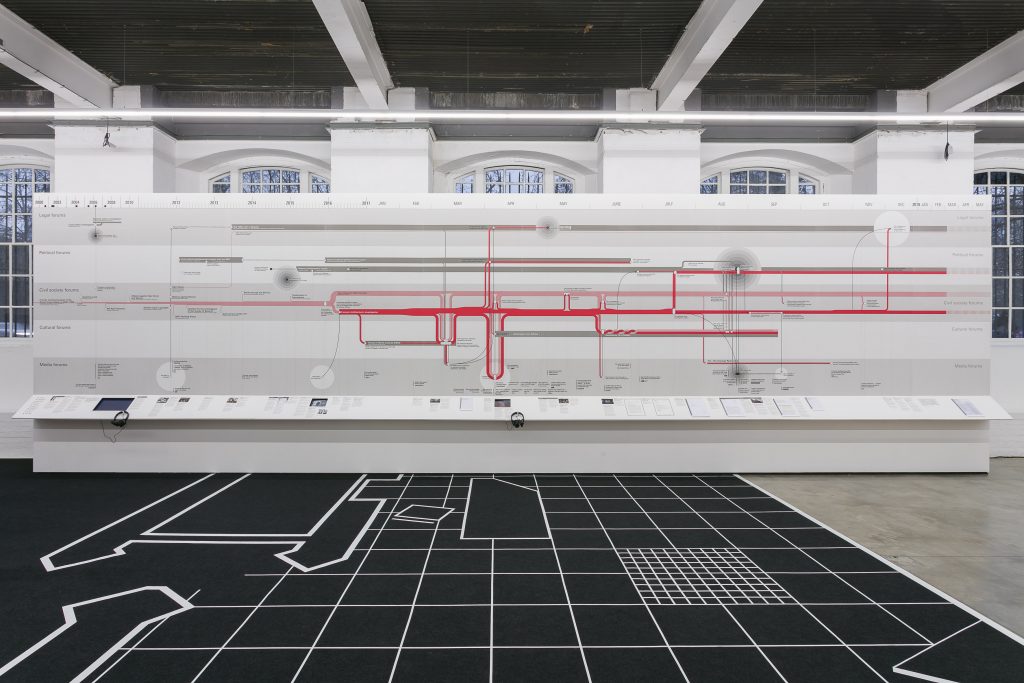
77sqm_9:26min makes testimony something that can be ruled out. Its timeline gives each person a row on a minute-by-minute axis (Figure 1). Solid lines show people at a computer or the phone booth, fixed by rings with timestamps from login and phone logs. A capsule marks an event the log can only place within a few seconds; its width is the uncertainty (07:42) (Figure 2). Only Temme is yellow. After he logs out at 17:01:40 his line turns dotted: his own account of moving through the front of the shop, lasting one minute and seven seconds (08:59). Records and testimony are drawn differently, then put on one axis, where they can clash.

Figure 1 A visual representation of the text-based timecoded information leaked to the public domain, and subsequently used by Forensic Architecture’s investigation. (Forensic Architecture)
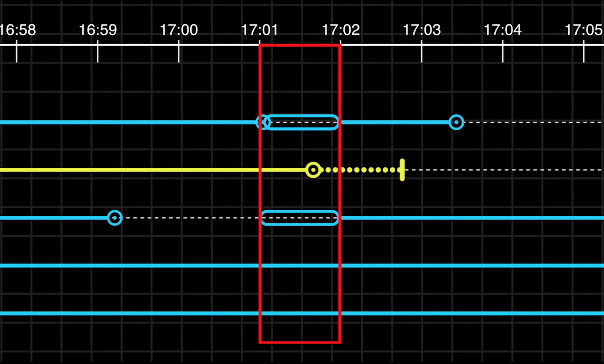
Figure 2 The capsule
The clash is the method. The film sets out three scenarios: Temme had left, he was in the front of the shop, or he was still at his computer. The first needs the murder to fit into a 39-second gap, between the end of his dotted line and the end of Faiz H.S.’s call. Re-enacted with no pauses, the sequence takes 35 seconds, so the pauses could total 4 seconds at most. The witnesses’ calls put the shots between 17:01 and 17:02. Together these rule out the first scenario using Temme’s own timings. This triangulation does not end on one agreed story. It shrinks the space of possibilities until one claim has nowhere to stand. The film is a translation too: its drawing keeps only what its question needs (could Temme have witnessed the murder?), and its choices are checked by the evidence.
Girotondo makes the same move on a different axis
Girotondo also records how a claim is known. Each interview page is set on a grid of seven by twenty-eight, and every phrase that describes my grandmother, or an exchange with her, gets a mark where it is said. A blue ring marks something about her own ability, expression or state. A ring in the speaker’s colour shows how the speaker knows: one ring for something they lived through, two for a judgement or comparison, three for an inference. A slash says the state is absent, a dashed line marks a hedge or an admission that memory is incomplete, and an arrow runs from a stated cause to its effect. These rings belong to the Change chapter; each of the book’s five chapters has its own rules. Like Forensic Architecture, the system puts claims on one shared structure so that they can be compared.
But the structure is different. Forensic Architecture’s axis comes from the world: a clock, fixed by logs. Mine comes from the page, and measures nothing outside it. Forensic Architecture also states its question before it draws anything. Some of my categories were already in my interview questions before anyone answered, such as waiting for her to finish versus finishing her sentence. So my rules partly record choices I made in advance. This is what the second translation does: the visual shows not what the interviewees said but what I chose to notice.
Take one passage from my sister’s page (Figure 3). She says communication has become harder, because she has become more stubborn and sometimes ignores what you say. The drawing keeps the claim and the reasons: rings for “stubborn” and “ignores”, with two arrows running from them into a ring at “harder”. It keeps one absence, a slashed ring where she says there is no problem with her language. It loses the order, because she said “harder” first. It loses her “wait, what is this interview for?”, which questions whether I can assume there was a change at all. The cold form is deliberate: it lets the reader see what it cannot hold.
Leave a Reply