Δ3 Synthesis
My research asks how a person is reconstructed through the memories and interpretations of others when her own voice becomes increasingly inaccessible, and how graphic communication can make that reconstruction visible. My position is that design cannot recover such a person, but it can show the translations through which she is known, including the designer’s own. I arrived at this position by following one question through Unit 2.
At the start of the unit, my line of enquiry asked whether typographic form could work as a record of reading rather than a vehicle for content. I set a fixed text, the final diary entries of Daniel Keyes’s Flowers for Algernon, so that the page carried what I felt while reading it, and behind that feeling was my grandmother, whose language was changing because of Parkinson’s disease. Walter Benjamin’s “The Task of the Translator” ([1923] 1969) and Roland Barthes’s claim, as Michael Rock reads it in “The Designer as Reader” ([1996] 2013), that every reading is a projection, gave me the frame: the reader’s presence is the subject of the work, not a distortion of it. The question I set myself was whether type should be read, felt, or both, and whether one reader’s feeling could be recorded precisely enough for another person to sense it.
A Life in Type (2026), an interactive website I designed and built, carried this question to many readers. Users entered their birthday, shaped eight words in a short monologue according to how each felt to them, and received a poster that joined an online archive. But I had also moved away from my grandmother. Using her illness as material had begun to feel like consuming it, so I turned to everyone’s feelings instead of hers and mine.
The last two projects showed me where I had drifted. The first was a dialogue with my tutor Jay Choo, whose questions, “Then?”, “Who says that?” and “What is unsaid?”, showed that the archive needed a purpose beyond collecting, that its shared meaning was partly my own assumption, and that the person behind the project had disappeared. I had to return to her without turning her loss into my material.
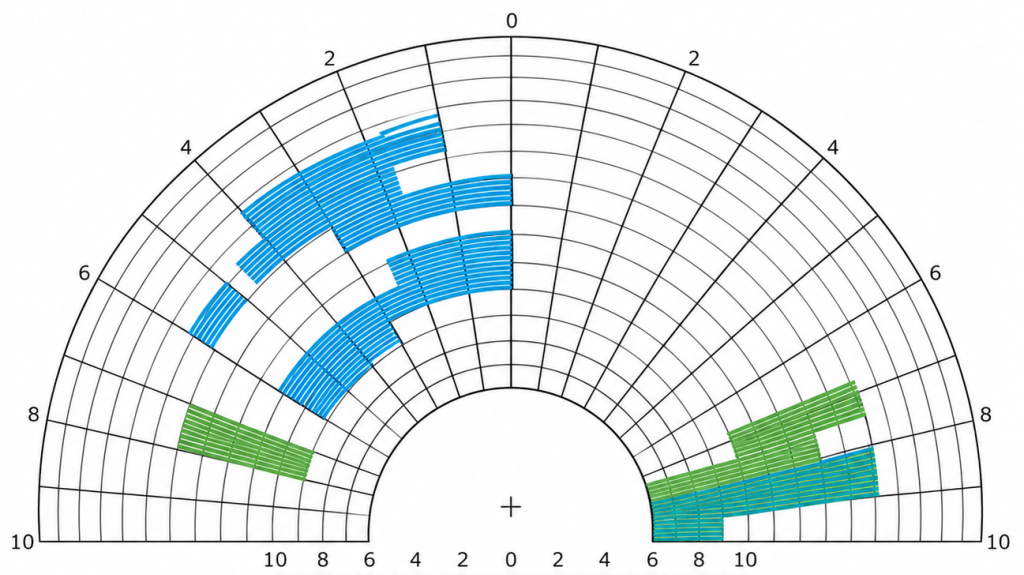
The second was triangulating against Forensic Architecture’s 77sqm_9:26min (2017), which places each witness on a minute-by-minute timeline fixed by login and phone records, so that testimony can be checked and ruled out. Girotondo, my publication built from interviews with my mother, my older sister and a friend, also places accounts on one structure: each transcript sits on a grid of seven by twenty-eight, every phrase about my grandmother is marked where it is spoken, and rings record whether the speaker saw, judged or guessed what they say. But their axis comes from the world and mine from the page. Their records narrow many accounts toward one truth, while my speakers can only be checked against each other, so more of them widen the picture of her. My rules do not find her; they are a second translation, made by me.
This reinforced translation as the core of the enquiry, while changing whose mark I study: first the reader’s, now everyone who speaks about her, including me. It also separated my feeling from her illness, separated feeling from knowledge, and exposed a risk in my own form, since geometry looks objective and readers may take these accounts as facts.
Projected forward, the question stays the same while the translation changes. Each interviewee paused, hesitated, lower their voices or laughed while speaking about my grandmother, and the geometry has no place for these moments. A second layer of expressive typography, drawn from the interview recordings, will carry how each person speaks, bringing the typographic work of A Life in Type back into the project, now tied to the speakers’ voices rather than my own feeling.
Leave a Reply