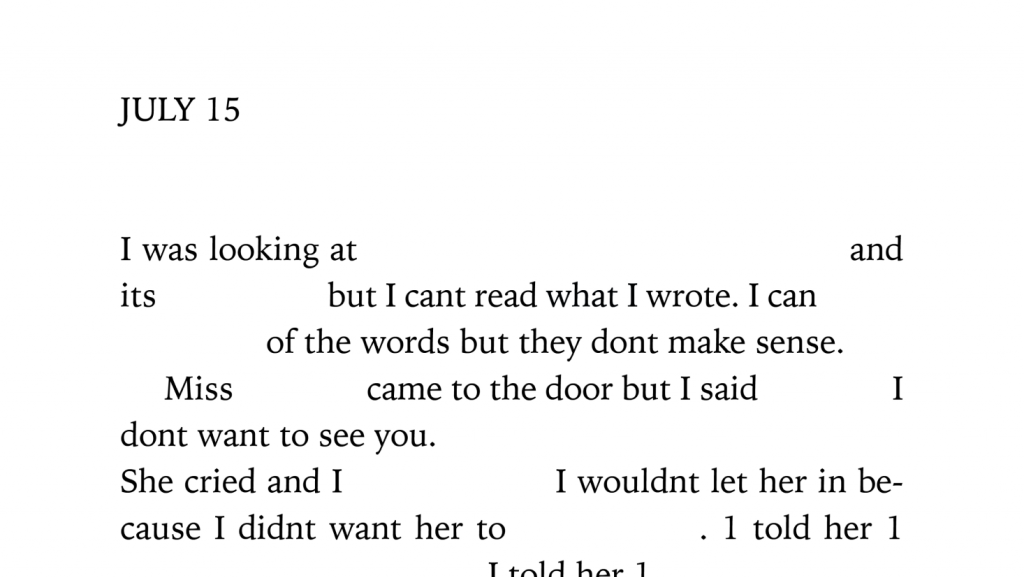
Week 1: Selection & Early Experiments — “When language fades, emotion becomes clearer”
At the beginning of this project, I started thinking about what “translation” could mean beyond language.
If translation is not just transferring words from one language to another but rather a process that shifts, distorts, and rebuilds meaning, I wanted to find material that already contained transformation within itself.
That’s why I chose Flowers for Algernon, particularly the final diary entries written by Charlie Gordon.
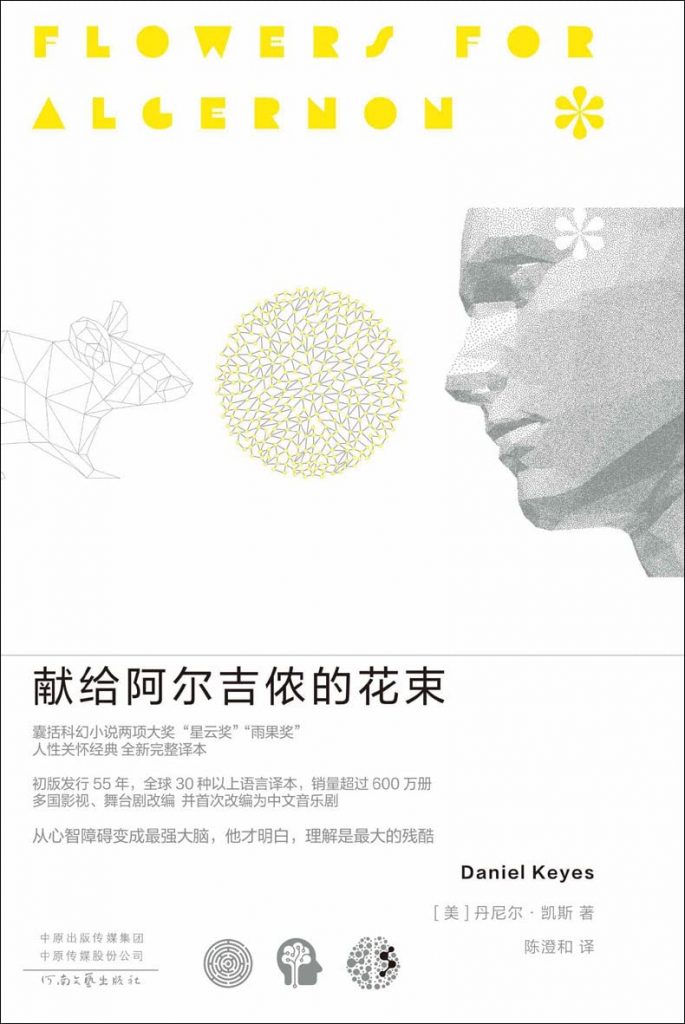
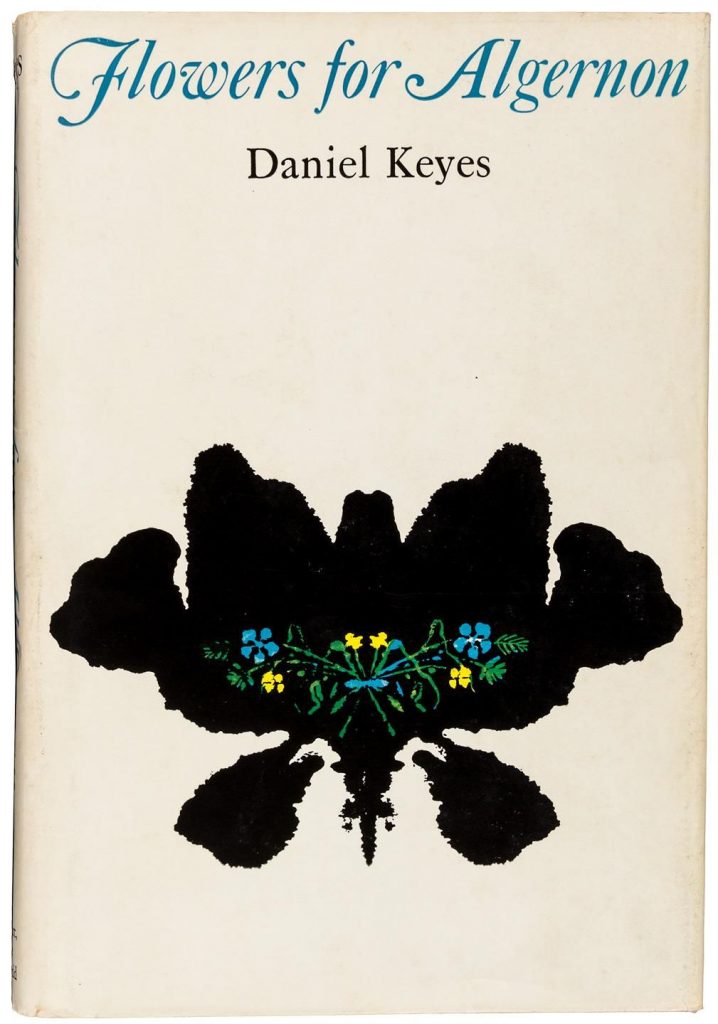
These texts already carry a strong sense of “translation” inside them:
- The same person, the same language,
- Yet, because of his reversed surgery,
- his writing moves from coherence → tension → fragmentation → near silence.
At first, I experimented with several directions:
- Comparing English and Chinese versions
- I noticed that the Chinese translation handled Charlie’s spelling errors differently, since those mistakes couldn’t be reproduced directly in another writing system.
- This made me realise that:“Errors” themselves carry emotional and psychological meaning — they are not meaningless noise but reflections of his state of mind.
- Time and structure analysis
- I tried arranging the diary entries chronologically, marking sentence length, grammatical complexity, and the density of mistakes.
- But this approach felt too analytical — more like a linguistic study than a “translation” in the creative sense required by the brief.
- Early visual experiments: translating emotion, not words
- I began to test how different degrees of visual distortion — overlapping text, blurred letters, uneven spacing — could recreate Charlie’s mental state.
- These early tests helped me clarify my goal:I didn’t want to retell the story;I wanted to translate the process of losing language itself.
Week 2: Personal Connection & Shifting Focus — From “Language Translation” to “Perceptual Translation”
The project changed direction when something personal happened.
Last week, I missed class because I had to return to Italy — my grandmother’s illness had worsened, and I stayed with her in the hospital.
She used to be a brilliant writer, someone who built her identity through language. But over just two weeks, she went from thinking slowly and occasionally hallucinating to living in constant fear and confusion, completely losing her ability to read and write.
This deeply resonated with Charlie’s story:
- Charlie became one of the most intelligent people in his lab,
- My grandmother was once an accomplished author.Both faced the painful process of losing the very ability that once defined who they were.
So I began to think differently about translation.
I didn’t want to “illustrate” the novel.
I wanted to translate what it feels like to become unable to express yourself —
to let perception itself carry the meaning.
That’s when I decided to focus on perceptual translation:
Translating language decline into changes of rhythm, clarity, and spatial tension in typography and layout.
I selected three key diary entries from different moments of Charlie’s decline and developed them into three posters —
each representing a stage in his cognitive and emotional deterioration.
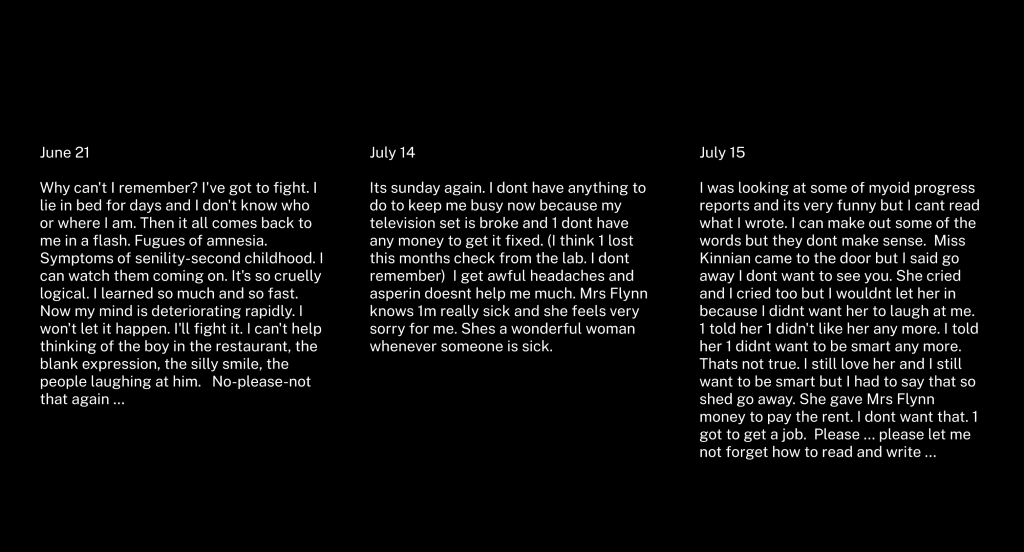
- Poster 1 – June 21: The beginning of struggle
- At this point, Charlie is aware of his regression but still trying to hold on.
- Visual strategy:
- Legible text but increasingly compressed and overlapping.
- The spacing tightens as if the words are fighting for air.
- Conceptually, it represents:His desperate attempt to remain coherent while knowing that coherence is slipping away.
- Poster 2 – July 14: Inner confusion
- This poster appears to be the hardest to read, with dense, tangled text.
- But conceptually, this represents a stage where:Charlie’s thoughts are still complex, but his ability to express them is breaking down.
- I wanted the design to feel like an overflowing mind with a blocked outlet —logic still exists inside, but expression is fragmenting.
- Poster 3 – July 15: The breakdown of language
- By this time, his sentences collapse; the missing words become the message.
- Visual approach:
- Large blank spaces and incomplete phrases;
- The most important parts are what’s missing.
- It’s no longer about what is written, but about what is no longer writable.He can’t form complete sentences, yet the silence itself still speaks of emotion.
Together, the three posters form a timeline:
legible but anxious → dense and chaotic → broken and silent.
They don’t narrate the story; they translate the psychological transition from awareness to helplessness.
Critical Reflection
What worked well
- A clear conceptual foundation connected with personal experience
- The project goes beyond formal experimentation to address a deeper question:What remains of a person when their language disappears?
- Linking Charlie’s fictional regression to my grandmother’s real condition adds emotional authenticity and ethical depth.
- Translation as reconfiguration
- Instead of translating word for word, I translated:
- Time → three visual moments
- Language → layout, spacing, opacity
- Reading → viewing and empathising
- This interpretation aligns with the brief’s focus on translation as transformation.
- Instead of translating word for word, I translated:
- Strong visual coherence
- Each poster shares a common aesthetic language, allowing viewers to perceive progression intuitively through form and clarity.
What didn’t work so well
- Limited scope of text
- Because of time, I only focused on the final entries.
- The early “high-intelligence” period is missing, so the overall emotional arc feels partial — more like an epilogue than a full trajectory.
- Static representation of a fluid process
- The posters effectively capture key moments but freeze what was originally continuous.
- Charlie’s loss of language was gradual; the medium of print makes it abrupt.
- Overlapping clarity and blur on one surface
- Having both clear and illegible layers on the same page sometimes confuses the viewer.
- The emotional experience competes with the urge to decipher.
Next Steps — From Posters to a Booklet
If I had more time, I would continue developing this project in two directions:
- Turn it into a booklet
- In the posters, clarity and distortion are forced to coexist on a single surface.
- In a booklet, I could separate them:
- Front side: the blurred, emotional visual translation.
- Back side: the original or retyped clear diary entry.
- This way, the viewer can first feel, then understand.The act of flipping the page becomes part of the translation — between chaos and comprehension.
- Extend the timeline
- Begin from Charlie’s most articulate writing after the operation,and end with his near-complete linguistic collapse.
- Page by page, the reader would witness how:
- Syntax breaks down;
- Vocabulary shrinks;
- Words disappear, leaving only fragments.
- This would visualise not only loss, but the emotional complexity of remembering what one can no longer express.
Leave a Reply