Written response 1
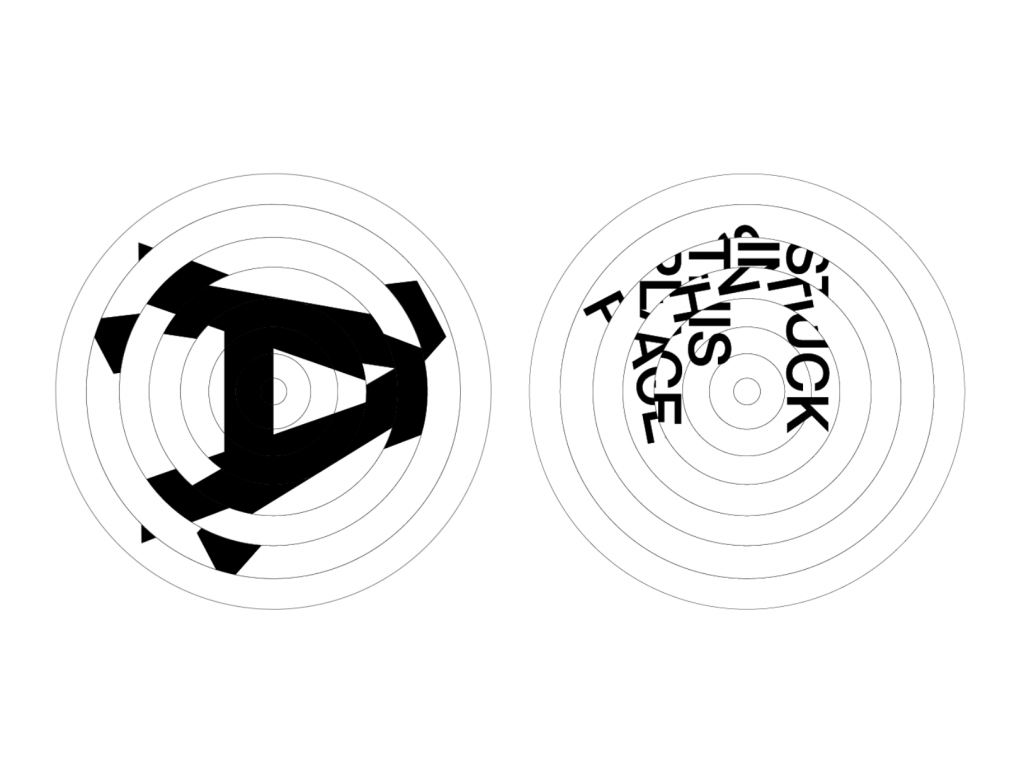
This project explores the transcription of audio signals into geometric motion. During the copying of the “Sequenced Plucks” project, a key question emerged: Should the priority be the visual “perfection” of the copy, or the “honesty” of a live, reactive system?
Initially, I used TouchDesigner to analyze the audio spectrum. However, the raw audio created significant “noise,” where overlapping frequencies triggered several rings at once rather than a single note. This conflicted with the reference, which likely uses clean MIDI data to achieve its “one-note-one-ring” precision. To solve this, I moved to After Effects to manually animate the rings using keyframes. While this allowed for perfect visual alignment, it removed the interactivity. The work became a static, pre-rendered animation rather than a living system responding to sound.
I propose a studio experiment that returns to TouchDesigner to embrace the “noise” rather than trying to hide it. Instead of using filter nodes to achieve a “clean” look, I will use these overlapping frequency signals to trigger intentional visual distortions or “glitch” effects.
The goal is to investigate if the “mistakes” of a live signal can create a more interesting visual language than a perfectly controlled manual animation.
Written response 2
Through Charles Jencks and Nathan Silver’s Adhocism: The Case for Improvisation, I reconsider my project as a question of system purity versus improvisation. Adhocism argues that design does not need to follow a single, unified logic. Instead, it can be built through temporary decisions and adjustments made in response to specific conditions.
While copying the project “Sequenced Plucks,” I discovered a clear difference between tools. The original work seems to use clean, separate input data, likely MIDI. This allows one note to control one ring in a precise and predictable way. However, when I used TouchDesigner with raw audio, the system behaved differently. The frequency spectrum is continuous and layered. One sound often activates multiple rings at the same time. At first, I saw this as a problem or technical noise.
Through the lens of Adhocism, I understand this overlap differently. Instead of correcting or filtering the audio to make it “clean,” I see the overlapping frequencies as material. The system does not need to isolate each sound into a single channel. Instead, different frequency bands can overlap and compete. Several rings may respond at once, creating a more complex and unstable motion.
This approach shifts the goal of the project. Rather than trying to perfectly copy the visual precision of the reference, I am interested in how a live system reacts to complexity. The animation becomes less about accurate transcription and more about negotiation between signals. Each visual outcome is not fully controlled in advance. It is assembled from temporary interactions inside the system.
Using Adhocism as a framework allows me to treat imperfection as structure rather than error. The system does not follow one fixed logic. It is built through small adjustments and local responses. In this way, the project becomes an improvised visual environment rather than a controlled reproduction of the original work.
Leave a Reply