Written response 1
Working with UAL’s waste data shifted my understanding of waste from a linear disposal process to a socio-material network. The spreadsheet revealed 909.48 tonnes distributed across 19 buildings, 19 waste types, 7,298 collection events, and 26 external destinations. Waste is coordinated through schedules, contractors, and treatment infrastructures. This complexity led me to reconsider climate justice within the context of the UAL Net Zero plan as a matter of institutional alignment across multiple actors and systems.
Engaging with Pelle Ehn’s discussion of “design things” (Ehn, 2008) further clarified this perspective. Ehn describes design things as socio-material collectives composed of human and non-human actors. Through this lens, the waste system can be understood as a public issue constituted by relationships among students, operational staff, vehicles, data records, and processing facilities. Within this framework, my role as a practitioner involves staging conditions where these interdependencies can be examined and negotiated. Design operates as a practice of organising relations within complex institutional systems.
reference:
Ehn, P. (2008) “Participation in design things,” Proceedings of the Tenth Anniversary Conference on …. portal.acm.org.
written response 2
Latour, B. (1986) ‘Visualisation and Cognition: Drawing Things Together’, Knowledge and Society, 6, pp. 1–40
Latour argues that science gains power not because people think more rationally, but because information is turned into inscriptions that can move, stay stable, and be combined. Facts become convincing when they can travel, be shown to others, and gather support in debates. This changed how we understood UAL’s waste data. The spreadsheet is not just neutral information; it is already part of an institutional system that organises reality. The workshop does more than display data. It reorganises waste into visible and movable units that can be compared and discussed. At the same time, Latour raises a critical question. If visual systems help create the power of facts, then design is not neutral. The project must therefore reflect on its own role in shaping how waste is understood, not only in revealing networks.
Blauvelt, A. (1994) ‘An Opening: Graphic Design’s Discursive Spaces’, Visible Language, , 28(3), pp. 205–217
Blauvelt argues that graphic design is not a neutral tool for communication. Design creates a discursive space, meaning it shapes how information is framed and interpreted. This idea helps position the Waste Workshop Kit as more than a visualisation project. The website, cards, and games structure how participants understand responsibility and coordination. The project therefore constructs a space where institutional information becomes discussable. Blauvelt also introduces a critical perspective. If design shapes interpretation, then every visual decision carries assumptions. The workshop, rather than just translate data, defines also how the waste system is seen and questioned.
Kolb, D. A. (1984) Experiential Learning: Experience as the Source of Learning and Development. Englewood Cliffs, NJ: Prentice-Hall
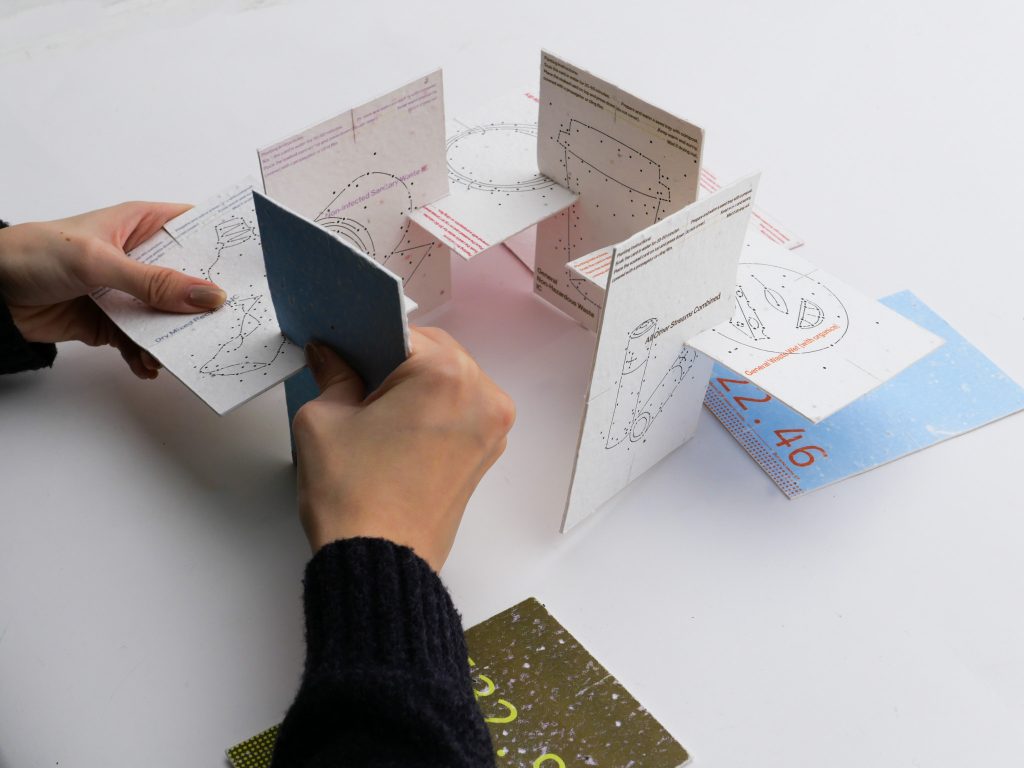
Kolb argues that learning is generated through the transformation of experience rather than the transmission of information. His model describes a structured cycle between concrete experience, reflection, conceptual clarification, and practical experimentation. This framework supports the Waste Workshop Kit as more than a set of environmental tips or sorting instructions. The workshop is organised as a staged encounter with the waste network. The opening segment introduces the scale of 909 tonnes, making institutional waste visible as a shared condition. The segregation activity tests understanding through applied decision-making, while the reuse pathways segment expands the focus from disposal to circulation and institutional coordination. The final handbook invites behavioural adjustment, yet this action emerges from a prior understanding of systemic interdependence. In this sense, the workshop is not centred on skill acquisition but on cultivating a systems-oriented awareness. Kolb’s theory clarifies how structured experience can shift perception from isolated acts of sorting to a broader recognition of waste as a coordinated network.
Meadows, D. H. (2008) Thinking in Systems: A Primer. White River Junction, VT: Chelsea Green Publishing
Meadows defines a system as a set of interconnected elements that generate patterns of behaviour over time, shifting attention from isolated events to underlying structures. Her concepts of stocks and flows, feedback loops, delays, and leverage points provide a framework for understanding waste not as a series of individual disposal acts but as a dynamic network shaped by institutional processes. This perspective directly informs the Waste Workshop Kit. The opening focus on 909 tonnes foregrounds waste as a stock, while the segregation and reuse segments reveal the flows and pathways through which materials circulate. Rather than training participants in sorting skills alone, the workshop seeks to shift their mental models, encouraging recognition of interdependence and systemic consequences. Meadows’ emphasis on changing the mindset of a system as a high leverage point strengthens the project’s educational rationale: behavioural adjustments become meaningful only when grounded in structural awareness. Her work positions the workshop as an intervention in perception, aimed at cultivating systems thinking within a university context rather than merely promoting sustainable habits.
Forensic Architecture (2010– ) Research agency based at Goldsmiths, University of London
Forensic Architecture develops investigative visualisations that translate complex political, spatial, and environmental events into structured, evidence-based representations. Their work demonstrates that visualisation is not neutral depiction but a method of assembling fragmented data into coherent arguments. By combining satellite imagery, mapping, modelling, and timelines, they construct environments in which viewers can understand distributed systems and causal relationships. This approach informs the Waste Workshop Kit in its attempt to reorganise institutional waste data into readable structures. While the project does not operate within a legal or forensic context, it adopts a similar logic of assembling dispersed information into spatially and materially legible formats. The emphasis is not on aesthetic expression but on structural clarity. Forensic Architecture challenges the assumption that data speaks for itself and instead foregrounds design as a mediator of complex realities. This perspective strengthens the project’s commitment to making waste infrastructure visible as a coordinated system rather than as isolated behavioural acts.
The Climate Museum (2018– ) New York
The Climate Museum positions climate change as a public learning environment rather than a distant scientific abstraction. Through exhibitions, interactive installations, and facilitated programming, it frames climate knowledge as something that must be collectively encountered and discussed. Rather than relying solely on informational display, the museum structures emotional, spatial, and participatory engagement to cultivate systemic understanding. This model is relevant to the Waste Workshop Kit in its attempt to move beyond awareness messaging toward structured educational intervention. The workshop similarly stages waste as a shared institutional condition and guides participants through sequenced encounters that connect scale, classification, circulation, and action. The Climate Museum demonstrates how environmental issues can be reframed as civic learning experiences, where knowledge is produced through engagement rather than passive reception. This precedent supports the project’s ambition to position waste literacy as a collective responsibility within the university context.
Leave a Reply