OPENING
“This project explores a question: when we encounter type, what are we
actually doing — are we reading it, or are we feeling it? And have those
two things ever really been the same?”
SCENE 1 — Origin
“This project didn’t begin with typography. It began with my grandmother.
She has Parkinson’s disease. Gradually, the illness took from her the ability
to hold words. I watched language leave her, slowly, like a tide going out.
Around the same time, I was reading Flowers for Algernon, a novel told
entirely through diary entries, where the protagonist’s intelligence rises and
then falls. The writing itself deteriorates with him. For my first project, I
tried to translate those final diary entries — not neutrally, but through her.
Charlie was writing through the experience of losing his mind. I was reading
Charlie through the experience of losing her.
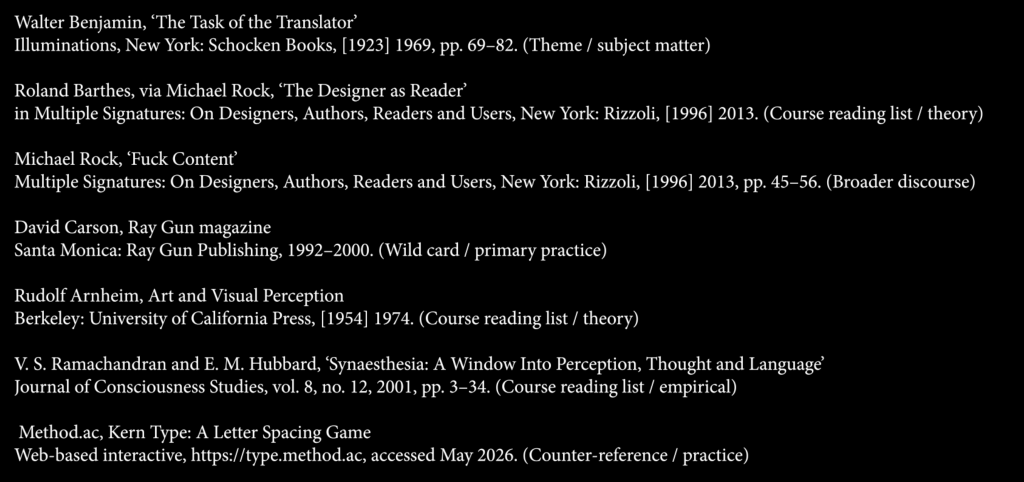
Walter Benjamin wrote that translation is not a transparent transfer of meaning, the original passes through a new body, and that body leaves its mark.
Roland Barthes said every reading is a projection. The reader’s subjectivity
is not a distortion of the text. It is the condition of reading.
SCENE 2 — The System and Its Limits
“In the next project, I tried to approach this systematically. One fixed text.
Four typographic parameters, leading, tracking, font size, inclination. All
values in multiples of five, introduced sequentially across a hundred pages.
The question was: does the reader feel the shift in cognitive state as the
parameters change?
They did. But everyone felt something different.
So I stopped trying to analyze other people’s responses before I had understood
my own. I made a second publication, each page a record of my own reading,
the typography shifting with my thinking, governed not by a rule, but by
experience.
That made me realize: two people can read the same sentence and inhabit
completely different emotional spaces. The text doesn’t change. The reader
does. The question is what happens in the gap between a mark on a page and
the person who encounters it.”
SCENE 3 — The Theory
“Michael Rock argues that treatment is itself a text. Not decoration. Not
style. A language as complex as the words it shapes. Our what is a how.
Rudolf Arnheim showed that visual form carries expressive weight before we
consciously process it. A rising line and a falling line are not emotionally
equivalent.
Ramachandran’s bouba-kiki effect proves this isn’t metaphor. It’s measurable.
95% of people across languages map the same abstract shape to the same word.
Form speaks before language does.
Kern Type tells you there is a right answer. David Carson spent four years
proving there isn’t. His layouts were deliberately illegible. They still
communicated, through weight, tension, rhythm. He didn’t mistake legibility
for communication.
Carson decided what type should feel like. But what if that decision belonged
to the reader?”
SCENE 4 — The Website
“If every reader’s experience is shaped by their own emotional history, I
wanted to find a way to make that visible. Not just observe it, but record it.
That curiosity led me to build a system where users translate their own feeling
into letterforms.
I chose extrapolation as my translation method, taking the logic of David
Carson and the Kern Type game into a new medium: an interactive website.
But what feeling? A human life moves through countless emotions, from the
very beginning to the very end. Born. Cry. Breathe. Remember. Laugh. Love.
Lose. Forget.
An early version simply invited users to interpret these eight words on their
own. But something was missing. I kept asking myself, when someone shapes
the word born, where does that understanding actually come from?
史铁生, a Chinese writer, described this precisely. He wrote:
‘I was born in 1951, but for me, 1951 came after 1955. One day in 1955 —
I remember the characters on the calendar were printed in green — time, for
me, began that weekend.
With this, I gave the website a narrative. These eight words are woven into a
single monologue: a shape that most lives follow. You enter your birthday,
and it begins.
SCENE 5 — The Archive
“When you finish, your monologue becomes a poster, a record of how you felt
each word. And those records accumulate in a collective archive, where your
version sits alongside everyone else’s.
That archive is the core of the project. Because the real question was never
just personal: is the felt response to type individual, or is there a shared
typographic language operating beneath conscious reading?”
Leave a Reply